How Foundation Drainage Problems Affect Homes Near Tulsa's Arkansas River
River-area soil, a high water table, and flat lots push water against Tulsa foundations. Here's how drainage fails, what it costs to fix, and when to call us.
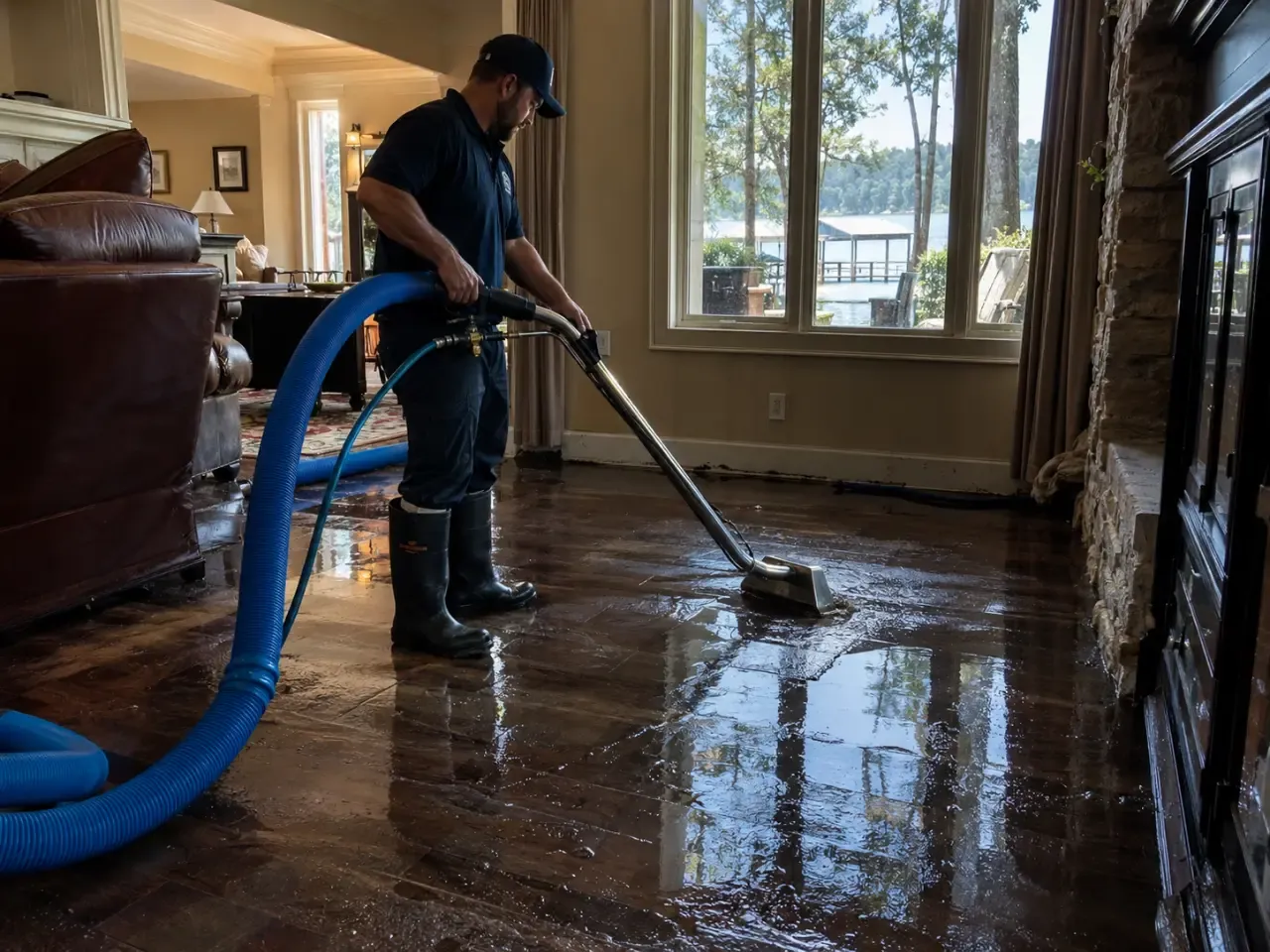
Foundation drainage problems near Tulsa's Arkansas River happen because the river's floodplain sits on layered sand, silt, and clay that holds water against your foundation long after the rain stops. When that water has nowhere to go, it finds the path of least resistance - your basement, crawlspace, or the joint where your slab meets the wall. We've pumped water out of hundreds of river-corridor homes, and the pattern is almost always the same: the drainage failed first, the water damage came second.
Below, we break down why river-adjacent lots drain poorly, what the warning signs look like, what repairs cost in 2026, and when it's time to call in a crew instead of a shop vac.
Why River-Adjacent Tulsa Lots Drain Poorly
Tulsa's river corridor sits on some of the flattest, most waterlogged ground in the metro, and that's the root of most drainage failures here. The Arkansas River carved a wide, shallow valley through this area, and what it left behind is a mix of sandy loam and dense clay that drains at wildly different rates. Sand moves water fast; clay barely moves it at all. When you build a house on top of both, water perches on the clay layer and pushes sideways toward the nearest opening - usually your foundation.
There's also the water table. In neighborhoods like Riverside Water Mitigation, the water table can sit as shallow as 3 to 6 feet below grade during a wet spring. That's below the footing depth of most homes built before 1990. When the river runs high after a big rain, the water table rises with it, and hydrostatic pressure builds under your slab. Concrete is strong, but it's not waterproof. Water will push through hairline cracks, cold joints, and the cove joint where the slab meets the stem wall.
Finally, there's the grading problem. Most river-corridor lots were graded to drain toward the street when they were built. Decades of settling, new landscaping, and added patios have changed that. We regularly find lots where the soil now slopes back toward the house - sometimes by 2 or 3 inches over 10 feet, which is enough to send every downspout's worth of water straight into the foundation.
How Poor Foundation Drainage Affects Tulsa Homes Near the Arkansas River
Foundation water intrusion near the Arkansas River in Tulsa shows up as seepage, efflorescence, musty odors, and eventually structural movement. The damage rarely happens all at once. It builds over seasons.
Here's what we see, in order:
- Capillary action through the footing. Water wicks up through the concrete and evaporates inside the basement or crawlspace, raising indoor humidity to 65% or higher.
- Cove joint seepage. The joint between the slab and the wall is the weakest point in any foundation. Once water sits against it, it leaks.
- Wall cracks. Hydrostatic pressure opens existing shrinkage cracks wider. A hairline crack at 0.01 inches can pass a quart of water per hour during a storm.
- Floor heave and wall bowing. Saturated clay expands. We've measured floor slabs that rose 1.5 inches over two wet seasons, cracking tile and binding doors.
- Mold and rot. Within 48 to 72 hours of a wet event, mold can colonize framing, drywall paper, and carpet pad. That's when a drainage problem becomes a health problem.
If you catch it at step one or two, you're looking at a drainage fix. If you catch it at step four or five, you're looking at structural repair plus water damage cleanup Tulsa and possibly mold remediation. The difference in cost is not small.
Signs of Groundwater Intrusion in a Tulsa Home
Signs of groundwater intrusion in a Tulsa home are usually visible before you ever see standing water. Your house tells you it's wet long before your basement floor does.
Watch for these:
- White chalky stains on the foundation wall. That's efflorescence - mineral salts left behind when water evaporates. It means water is moving through the concrete.
- A musty smell in the basement or lowest level. If it smells like a wet basement, it is one, even if the floor looks dry.
- Cupping or buckling hardwood floors. Wood absorbs moisture from below and swells on the underside first.
- Condensation on cold water pipes in summer. High indoor humidity from below-grade moisture condenses on the coldest surface in the room.
- Doors and windows that stick more in spring than fall. That's seasonal soil movement from saturation.
- Hairline cracks that darken after rain. A crack that looks wet is a crack that's leaking.
If you see two or more of these, you have a drainage problem. It's not a question of whether water will enter - it's a question of when the next big storm pushes it through. When that happens, our emergency water extraction Tulsa crew can be on-site the same day to pull standing water and start drying.
Does Poor Grading Cause Foundation Leaks in Tulsa?
Yes - poor grading is the single most common cause of foundation leaks we find in Tulsa, and it's also the cheapest to fix. The rule of thumb is simple: soil should slope away from your foundation at a minimum of 6 inches over the first 10 feet. We measure this on every inspection, and roughly 7 out of 10 river-corridor homes we visit fail that test.
Three grading problems show up over and over:
- Negative slope. The ground tilts toward the house instead of away. Usually caused by settling backfill or a new patio poured too high.
- Flat or buried foundation drains. Many homes built before 1985 have a perimeter drain tile that's either clogged with roots or crushed by settling. A drain that doesn't drain is worse than no drain, because it holds water against the wall.
- Downspouts that dump at the foundation. A single downspout can discharge 12 gallons per minute during a heavy Tulsa storm. If it empties within 3 feet of the foundation, you're watering your own basement.
The fix is usually a combination of regrading, extending downspouts 6 to 10 feet from the house, and clearing or replacing the perimeter drain. For homes in older neighborhoods like Maple Ridge Water Mitigation, where mature trees have invaded drain lines for decades, we often recommend a full drain replacement rather than repeated snaking.
What to Watch Out For
The biggest mistake we see homeowners make is treating the symptom instead of the cause. A wet-vac and a dehumidifier will dry a basement, but they won't stop the next storm from flooding it again. Here's what to avoid:
- Sealing cracks from the inside only. Hydraulic cement and epoxy injection stop the visible leak, but they don't relieve the water pressure outside. The water will find another crack - often within a year.
- Ignoring the first wet spot. A damp corner in April becomes a flooded basement in May. Water damage compounds.
- Running a dehumidifier without fixing the source. You'll pull 5 to 10 gallons a day out of the air and never solve the problem. That's a $40-a-month electric bill for nothing.
- Letting a "handyman" regrade without checking the drain tile. If the perimeter drain is crushed, new topsoil just hides the problem.
- Waiting to call after a flood. Mold starts within 48 hours. The longer water sits, the more of your home has to be removed and replaced.
One more thing: don't assume a newer home is safe. We've worked on river-corridor houses built in the 2010s that had drainage issues from day one because the builder graded to the lot line instead of away from the foundation.
When to Call a Professional
Call a professional when you see water where it shouldn't be - period. A damp basement wall, a wet crawlspace, a musty smell that won't go away, or a floor that's started to buckle are all signs that the drainage has already failed and water is actively moving through your foundation.
At Tulsa Water Shield, we handle the whole chain: we find where the water is coming in, extract what's already there, dry the structure, and treat for mold if it's started. We don't hand you off to three different contractors. One crew, one invoice, one point of contact from the first call to the final moisture reading.
If you're not sure whether you have a problem, call us anyway. A 20-minute inspection is a lot cheaper than a flooded basement. We serve the entire river corridor and the surrounding Tulsa neighborhoods, and we can usually get a technician out the same day.
Frequently Asked Questions
Can foundation drainage problems cause water intrusion near Tulsa's Arkansas River?
Yes. When perimeter drains clog and the water table rises with the river, hydrostatic pressure pushes water through footing joints and cracks. Homes within roughly a half-mile of the river are at the highest risk, especially during spring storms when the river runs high for weeks.
How can I tell whether groundwater is entering my Tulsa home?
Look for efflorescence (white chalky stains) on foundation walls, a musty smell in the basement, cupping hardwood floors, and cracks that darken after rain. If you see two or more, groundwater is almost certainly entering. A moisture meter reading above 20% on a basement wall confirms it.
Does poor grading cause foundation leaks in Tulsa?
Yes - it's the most common cause we find. Soil should slope away from the foundation at least 6 inches over 10 feet. Most river-corridor lots we inspect fail that test, usually because of settling backfill or landscaping that changed the grade.
When should I call a water mitigation company for foundation seepage?
Call as soon as you see standing water, a wet wall, or a musty smell that won't clear. Mold can start within 48 hours, so the first day or two matters most. If you're unsure, call anyway - an inspection is cheap compared to a flooded basement.
How can homes near the Arkansas River reduce water damage risk?
Regrade the soil to slope away from the foundation, extend downspouts 6 to 10 feet, keep gutters clear, and have the perimeter drain inspected every 2 to 3 years. A sump pump with a battery backup is also worth installing if your basement floods more than once.
Get Help with Water Mitigation in Tulsa
If water is finding its way into your foundation, we can stop it and clean up what it left behind. Tulsa Water Shield handles water mitigation services Tulsa, OK for river-corridor homes - extraction, drying, mold treatment, and drainage repair, all from one crew.
Call us at (918) 848-9096. We answer 24/7, and we can usually have a technician at your door the same day.